
A Basic Guide to Tuning Timpani
This is a Basic Guide for teachers and general music specialists about the Timpani. This is a non-technical explanation for non-percussionists! The subject of tuning Timpani in detail is a huge one, that I could probably write a whole book about. This articles is a quick little explanation for general music teachers and band teachers about the Timpani and how to tune them.
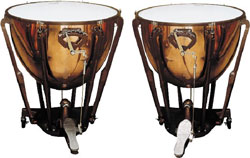 Tuning a Timpani refers to the process of using the pedals to change the note on a drum – which can be done between pieces or in the middle of the piece if required.
The tuning of the tuning rods around the edge should be left to a percussion specialist – as it a difficult procedure beyond the scope of this article! A service by a professional would be desirable once every two years, or if the timpani are not sounding in tune.
The pedal changes the pitch of the drum by tightening or loosening the skin. When you push the pedal down to tighten the skin it raises the pitch, and when you loosen it the pitch lowers.
Most timpani are equipped with a gauge – a mechanical device attached to the side of the drum which indicates the tension, and thus the note heard.
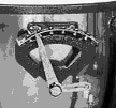 The Gauge consists of a row of letters (letter names for the notes of the timpani), and a arrow device which moves when you adjust the pedal. To change notes therefore, you need to watch the gauge and move the pedal so that the arrow points to the note that you need.
In a perfect world the timpani would never need to be adjusted, so that the player could always use the gauge to set the desired note. However, due to changes in temperature and environment you cannot always depend on the letters being in the right places.
At the start of rehearsal or before a performance the timpanist must “set the gauges” or move the letters indicating where the notes are, so that the arrow device accurately lands on the right note.
If a piece only has fixed notes, and does not require changing then there is no need to set all the letters on the gauge – you only need to set the notes you are going to use on each timpani.
The process of doing this is the most difficult for young players at first.
Here is my basic method:
1) Release the pedal (so the drum is at its lowest note)
2) Play the note you are tuning to on a fixed pitch instrument (such as a piano or marimba, or you can use a pitch pipe)
3) Sing the note in your head or out loud (softly of course!)
4) Hit the drum once
5) Slowly push the pedal down until your ear can hear the sustain from the struck note coming into tune with the reference note.
6) Once you have heard the note come into tune, take your foot off the pedal and set the letter of the note you have just tuned, as the pedal should stay in the same place.
Most young players move the pedal too fast – therefore overshooting the note, or they fail to get the reference note in their heads in the first place.
New timpanists must practice, practice & practice this until they can do it reliably. The teacher must master the skill themselves and then be able to communicate it to the students.
Some timpanists do use electronic tuning devices; however they are not always reliable for timpani due to the harmonics which are present. Tuning “by ear” is always a much preferred method, even if it is more difficult at first.
You can learn more about Timpani in the Fun Music Company Music Lesson Plan series on instruments of the Orchestra from the Fun Music Company.

 Follow us on Facebook
 Follow us on Twitter
 Subscribe to our blog